

What Is a Static Voltage Stabilizer? Working Principle, Types and Applications
A static voltage stabilizer is an AC voltage regulation device that uses power semiconductors to adjust voltage during normal operation, without a servo motor moving a regulating brush. When the supply voltage or connected load changes, its control system adjusts the output to keep it within the specified tolerance.
The word “static” describes the regulation method. For example, Winzele’s SCR static voltage stabilizers use thyristors to switch transformer compensation states, while its WPZ IGBT voltage stabilizers use an AC–DC–AC circuit with rectification and inversion. Understanding these two architectures helps explain their different functions and applications.
What Does “Static” Mean?
A servo voltage stabilizer uses a motor to move regulating brushes, correcting the output through a regulating or compensation circuit. A static stabilizer performs this function through semiconductor switching or power conversion, without motor-driven movement of the regulating contacts during normal voltage adjustment.
Static designs therefore reduce mechanical regulating components. They can still contain cooling fans, contactors and other components that require attention. Cooling, electrical connections, protective devices and power modules all remain part of routine inspection and maintenance.
Common terms in product documentation include:
| Term | Meaning |
|---|---|
| Static voltage stabilizer | Regulates voltage without motor-driven brush movement during normal adjustment. |
| SCR / thyristor stabilizer | Uses thyristors to select transformer compensation states and polarity. |
| IGBT stabilizer — Winzele WPZ example | Uses rectification, IGBT inversion and an output isolation transformer. Other IGBT-based products may use different architectures. |
| AVR | Automatic Voltage Regulator: a broad term that includes both servo and static voltage regulators. |
How Does a Static Voltage Stabilizer Regulate Voltage?
The basic process is to measure the voltage, compare it with the target, make an adjustment and use feedback to continue correcting the output. In Winzele’s SCR design, the adjustment involves switching transformer compensation states; in the WPZ design, it involves PWM-controlled inversion.
The measuring circuit samples the voltage, and the controller compares the measured value with the setpoint. If there is a deviation, it sends commands to the power circuit to raise or lower the output. This process continues as supply and load conditions change.
For example, starting another large machine in a workshop may briefly reduce the supply voltage. Changes in a machine tool’s operating cycle can also affect load current and voltage at its input. Different static stabilizers use different control methods, but share the purpose of regulating the output voltage.
SCR Thyristor-Based Transformer Compensation
In Winzele’s SCR series, the controller uses thyristors to select the transformer compensation state, including the amount and polarity of the correction voltage. When the input is low, the circuit adds a positive compensation voltage. When the input is high, it applies a negative compensation voltage.
In simplified form:
Output voltage = Input voltage ± Compensation voltage
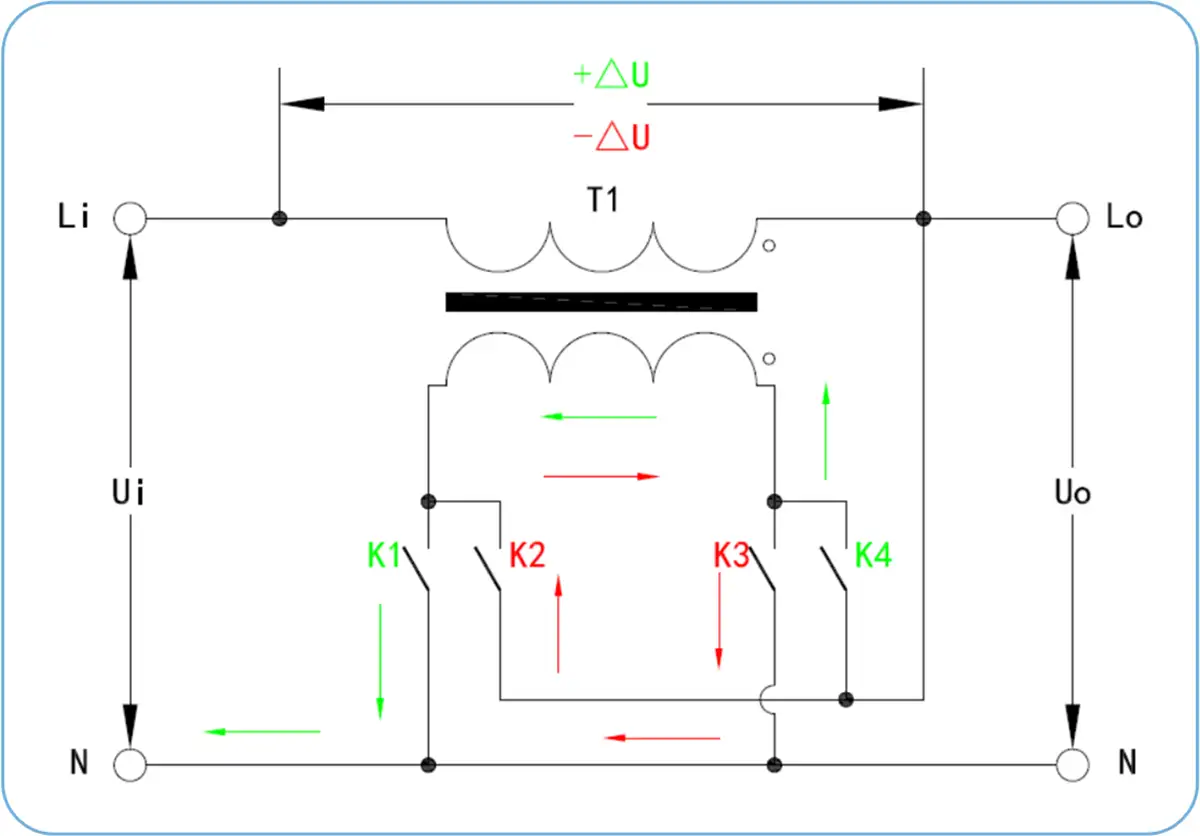
Compensation principle of the Winzele SCR series.
No servo motor or moving brush is needed for this adjustment. However, the transformers and power devices still have rated operating limits. Input voltage, load current and cooling conditions together determine the compensation capability that the equipment can sustain.
WPZ Series: AC–DC–AC Conversion
The Winzele WPZ series first rectifies the incoming AC supply to a DC link. An IGBT inverter then generates a controlled AC output. The system includes an output isolation transformer, with output voltage and frequency controlled according to the selected configuration.
This power conversion architecture differs from SCR transformer compensation. Where a site experiences both voltage fluctuations and frequency deviations, WPZ can be configured to address both requirements.
IGBT is the name of a power semiconductor, not a complete circuit architecture. Other IGBT-based equipment can use different power paths. For example, ABB’s PCS100 AVC-40 and Schneider Electric’s PowerLogic DVR use transformer-coupled correction voltage injection. These should not be assumed to have the same architecture as WPZ. A system block diagram helps identify how the rectifier, inverter, transformer and load are connected. See the ABB PCS100 AVC-40 user manual and Schneider Electric’s PowerLogic DVR architecture guide.
Which Performance Parameters Matter?
“Static” describes how voltage is regulated. Actual performance depends on the product specifications. Three areas are particularly important for equipment users.
Input range and output tolerance. Do the site’s highest and lowest voltages fall within the stabilizer’s operating range? Does the output tolerance meet the connected equipment’s requirements? These questions need to be considered together.
Continuous and starting loads. Normal operating current provides the basis for capacity selection. Peak currents from motors, compressors and cyclic loads must also be assessed together with their duration. Permissible load capacity at low input voltage matters as well.
Response and recovery. Detecting a voltage change, beginning an adjustment and bringing the output back within tolerance are different points in the process. Dynamic performance comparisons should use the same input disturbance, load conditions and acceptance criteria.
Frequency control, surge protection, harmonic mitigation and backup power each have separate requirements beyond voltage regulation. For example, the output frequency of an SCR compensation system follows the input, while WPZ can control output frequency according to its configuration. DC-link capacitors provide a short-term energy buffer, but sustained power during an outage requires additional energy storage or a backup supply.
Two Projects with Different Supply Requirements
Shanghai: TRUMPF TruPunch 2000 CNC Punching Machine
A precision sheet metal processing project in Shanghai used a 50 kVA SCR static voltage stabilizer to regulate the AC supply at the input of a TRUMPF TruPunch 2000 punching machine.
The 50 kVA rating was the configuration used for this project. Capacity for other punching machines should be calculated from equipment input current, starting conditions and the site supply. View the TRUMPF project.
Vietnam: DONGKWANG Precision Electronics Factory
DONGKWANG COMPANY LIMITED’s precision electronics factory in Vietnam faced both supply voltage fluctuations and frequency deviations. The project used a 200 kVA WPZ33200 to supply the relevant production loads with 380 V at a fixed 50 Hz.
The requirement included frequency stabilization as well as voltage regulation, which is why the project used the WPZ AC–DC–AC solution. View the Vietnam WPZ project.
Both projects used static voltage regulation, but their tasks differed: one regulated the supply to a machine tool, while the other required both voltage and frequency control. Selection should start with the supply problem and the load requirements. More projects are available in the static voltage stabilizer application library.
How to Start Selecting a Stabilizer
Begin by gathering three groups of information:
- Equipment requirements: Number of phases, rated voltage and frequency, permissible voltage deviation, continuous current and starting current.
- Site measurements: Highest and lowest voltages and the timing of abnormal events. For voltage sags, record depth and duration; for frequency deviations, record the variation range.
- Installation conditions: Available space, ventilation, electrical interfaces and supply arrangements during operation and maintenance.
This information helps establish whether the project mainly requires voltage compensation or also needs functions such as frequency control, so the appropriate product architecture can be selected.
For a detailed comparison of the available technologies, read the Servo vs SCR vs IGBT voltage stabilizer selection guide. To explore the product range, visit the static voltage stabilizers category.


