

Servo vs SCR vs IGBT Static Voltage Stabilizer: Selection Guide
Introduction
Industrial voltage can fluctuate because of grid conditions, motor starting, changing production loads, or long distribution lines. An industrial voltage stabilizer corrects sustained undervoltage, overvoltage, and dynamic changes before they affect connected equipment.
Three regulation architectures address different requirements:
- SBW Servo Voltage Stabilizer: Transformer-based electromechanical regulation
- SCR Static Voltage Stabilizer: Transformer-based semiconductor switching regulation
- IGBT Static Voltage Stabilizer: AC-DC-AC inverter-based voltage compensation
SBW provides continuous motor-driven transformer adjustment, SCR provides contactless thyristor switching, and IGBT provides PWM-controlled inverter compensation. None is universally better. The appropriate technology depends on the voltage fluctuation profile, load, response requirement, capacity, and installation conditions. This voltage stabilizer selection guide compares the architectures for engineering and procurement evaluation.
1. Compensation Principle Comparison
| SBW Servo Compensation Principle | SCR Static Compensation Principle | IGBT Inverter-Based Compensation Principle |
|---|---|---|
 |
 |
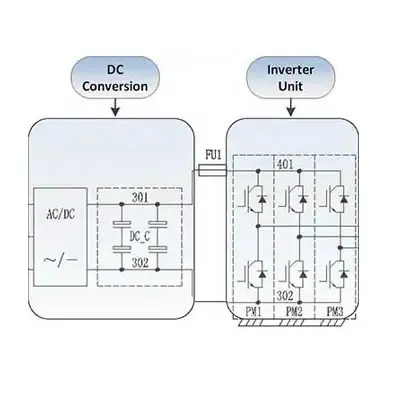 |
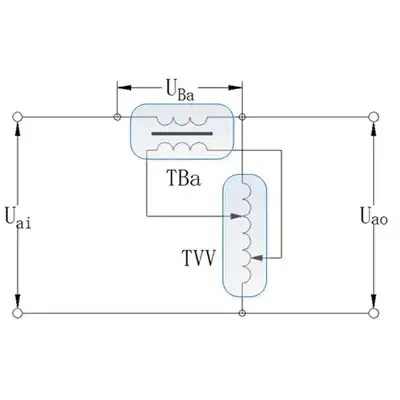
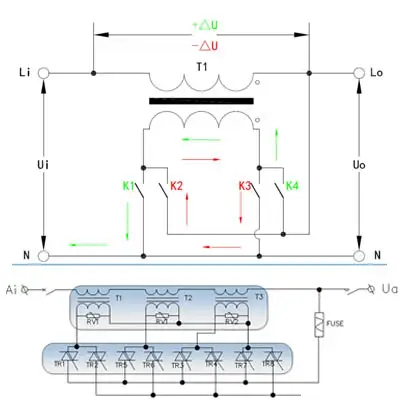
| A controller detects voltage deviation and drives a servo motor to reposition the contact on the regulating transformer. The resulting continuously adjustable voltage feeds a compensation transformer, which injects buck or boost voltage into the main circuit. Injection polarity determines whether the output is raised or lowered. | An SCR/thyristor power array electronically selects the required compensation state and polarity. Transformer windings provide the correction voltage, and the compensation transformer applies it to the line. The controller changes the conducting path without motorized movement, providing contactless regulation. | An AC/DC rectifier supplies the DC link, supported by a DC-link capacitor. The IGBT inverter bridge uses PWM to generate a controlled compensation waveform. Changing the PWM command controls correction amplitude and polarity. An output transformer couples this voltage into the load supply path. |
2. Internal Structure Comparison
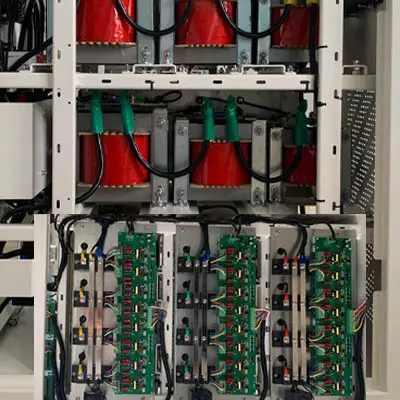
| SBW Internal Structure | SCR Internal Structure | IGBT Internal Structure |
|---|---|---|
 |
 |
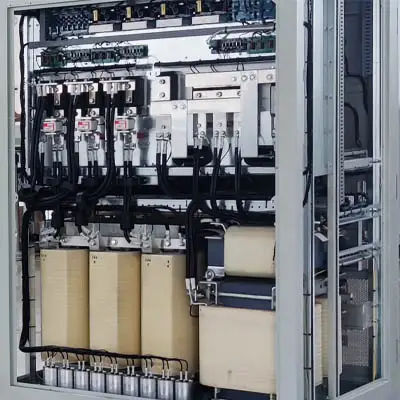 |
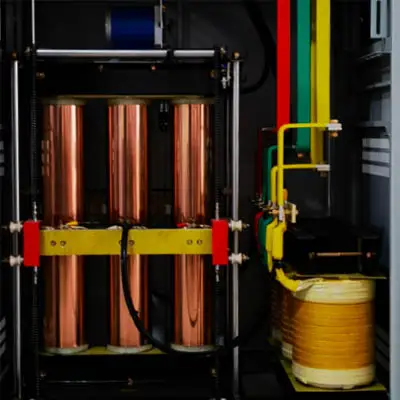
| The cabinet contains three vertical copper regulating columns, a large wound compensation transformer assembly, color-coded connections, and a supporting enclosure frame. The frame separates the wound assemblies, power connections, and mechanical drive area within the motor-adjusted transformer system. | Upper red-wound transformer assemblies are paired with repeated PCB-based power sections below. Heavy cables, heat-dissipation structures, and control wiring connect the thyristor power array to the transformer compensation section. The cabinet separates magnetic components from electronic switching and control assemblies. | The cabinet integrates the IGBT converter system, protection devices, control components, heavy power conductors, and an output transformer assembly. Upper hardware provides switching and protection, while lower magnetic components support transformer coupling. The layout separates control, power-conversion, and magnetic sections. |
3. Technology Comparison Table
| Item | SBW Servo | SCR Static | IGBT Static |
|---|---|---|---|
| Regulation Architecture | SBW Servo: Electromechanical transformer regulation. | SCR Static: Semiconductor-switched transformer regulation. | IGBT Static: AC-DC-AC inverter-based compensation. |
| Main Components | SBW Servo: Servo motor, regulating column, controller, compensation transformer. | SCR Static: Thyristor array, controller, transformer sections, compensation transformer. | IGBT Static: Rectifier, DC-link capacitor, IGBT inverter, controller, output transformer. |
| Moving Parts | SBW Servo: Motor-driven movement during regulation. | SCR Static: No motorized regulating contact. | IGBT Static: No motorized regulating contact. |
| Compensation Method | SBW Servo: Continuous transformer adjustment with buck or boost injection. | SCR Static: Electronic selection of transformer compensation state and polarity. | IGBT Static: Continuous PWM-generated inverter compensation. |
| Typical Applications | SBW Servo: Large industrial systems, factory distribution, motors, compressors. | SCR Static: Contactless regulation for machine tools, controls, and production loads. | IGBT Static: Sensitive electronics, precision equipment, test systems, dynamic loads. |
The comparison describes regulation architecture rather than overall quality. Actual performance also depends on the input range, controller design, transformer configuration, thermal management, protection system, and connected load.
Technology Selection Considerations
SBW suits large-capacity industrial systems and continuous voltage fluctuation. SCR suits contactless transformer regulation and fast semiconductor switching. IGBT suits inverter-based compensation and fast dynamic response. Final selection should consider voltage fluctuation characteristics, load type, capacity, and system requirements.
Frequently Asked Questions
1. What is the difference between servo, SCR and IGBT voltage stabilizers?
Servo technology adjusts a regulating transformer mechanically, SCR technology switches transformer compensation states electronically, and IGBT technology generates compensation through an AC-DC-AC inverter. Their regulation behavior, components, and application fit are therefore different.
2. Which technology is suitable for large industrial loads?
SBW is commonly selected for large-capacity factory distribution, motors, compressors, and production equipment. However, capacity is not the only criterion. Engineers should also check the input-voltage range, fluctuation speed, starting current, load profile, installation space, and maintenance requirements.
3. Does static voltage stabilizer always mean higher performance?
No. “Static” indicates that normal regulation does not use a motorized regulating contact. It does not define accuracy, capacity, overload capability, thermal performance, or suitability. SCR and IGBT systems also use different power architectures, so performance must be evaluated against the project specification.
Related Products
- SBW Servo Motor Voltage Stabilizer
- Static Non-Contact SCR Voltage Regulator
- IGBT Static Automatic Voltage Stabilizer


