
Five major hazards of harmonic pollution! Your equipment is quietly shortening its lifespan.
Harmonic pollution, which you can neither see nor touch: In factory workshops, brand-new motors overheat abnormally after only a few months; in precision laboratories, instrument data frequently drifts and becomes unpredictable; office computers and printers suddenly stop working more and more often… When these problems occur repeatedly, have you ever suspected that an invisible electrical problem is silently eroding your equipment? This is harmonic pollution.
01 What are harmonics?
Ideally, the voltage and current of the power grid should be smooth and pure sine waves (50Hz or 60Hz). However, the nonlinear loads widely used in modern equipment (such as frequency converters, rectifier power supplies, LED lighting, switching power supplies, arc equipment, etc.) inject a large amount of “impurity” current with frequencies that are integer multiples of the fundamental frequency (50Hz) into the power grid. These “pollute” the pure form of the current, forcing it to deviate from its sinusoidal trajectory and forming distortion—this is harmonics.
02 What serious consequences can harmonics cause?
Harm 1: Increased Equipment Overheating and Sharply Reduced Lifespan
Harmonic currents act as an additional high-frequency current burden in the system. When flowing through conductors, their heat loss follows Joule’s law (P = I²R). Due to their high frequency, harmonic currents exacerbate the skin effect (current tends to flow towards the conductor surface) and the proximity effect (magnetic field interaction between neighboring conductors), leading to increased effective resistance and heat generation far exceeding that of the equivalent fundamental current.
Excessive transformer temperature rise accelerates insulation aging, shortens lifespan, and forces capacity reduction (requiring derating). Overheating of cables and wires causes insulation aging, embrittlement, and even breakdown. Harmonic currents cause additional copper and iron losses in motors, resulting in decreased motor efficiency, excessive temperature rise, reduced output, and increased vibration and noise. Your equipment may be suffering from unseen “electrochemical erosion.”
Harm 2: The “Hidden Thief” on Your Electricity Bill
The extra losses caused by harmonics are directly converted into heat dissipation. This wasted energy is still recorded on your meter. More importantly, harmonics significantly increase reactive power (especially those caused by capacitive loads or specific harmonics). Many businesses include clauses on their electricity bills that impose penalties based on maximum reactive power or power factor; harmonic pollution directly causes these penalties to skyrocket. A typical factory without harmonic control can incur hundreds of thousands of yuan in extra electricity bills annually.
Harm 3: False Tripping and Unexplained Production Interruptions
Precision circuit breakers and relay protection devices are designed to respond to power frequency current/voltage. When strong harmonic currents (especially characteristic harmonics such as the 3rd and 5th harmonics) flow, the protection device is highly susceptible to misinterpreting them as fault currents, triggering unexpected power outages. Sudden shutdowns of automated production lines, critical server crashes, and scrapped precision machining processes… Unexpected downtime caused by harmonic pollution not only results in direct product losses but also severely disrupts production plans, undermines customer confidence, and has incalculable consequences.
Hazard 4: Disaster for Precision Equipment
For equipment that relies on precise voltage waveforms or sensitive electronic components (such as medical imaging equipment, precision measuring instruments, and control and communication circuit systems), harmonic pollution is catastrophic. Voltage waveform distortion can cause abnormal operation of the internal power supply, resulting in erroneous readings, data drift, image artifacts, and even logical errors. Interference with control system signals can trigger equipment malfunctions, seriously threatening production safety and product quality.
Hazard 5: The “Crushing Factor” of System Paralysis
Harmonic pollution causes cumulative and fatal damage to power system infrastructure:
5.1. Capacitors: Harmonic currents easily lead to overload, overheating, bulging, and even explosion of compensation capacitors (harmonic amplification effect).
5.2. Transformers: Additional losses (copper losses, iron losses) result in reduced capacity, overheating, increased noise, and a sharp reduction in insulation life.
5.3. Neutral Line: The superposition of third harmonics on the neutral line can cause an abnormal increase in neutral current or even overload (up to 1.7 times the phase current), burning cables or causing fires, posing a major safety hazard.
5.4. Generators: Harmonic currents cause rotor overheating and torsional vibration, threatening the safety of the generator itself.
The accelerated deterioration or failure of these critical infrastructure components may ultimately lead to the risk of paralyzing the entire power supply system.
03 How to deal with harmonics and solve the problem?
Response strategy: From detection to governance, protecting device health.
1. Harmonic Measurement:
Using a professional power quality analyzer, monitoring is conducted at key distribution points (such as transformer outgoing lines and important equipment incoming lines) to comprehensively capture key data such as harmonic voltage/current distortion rate (THDv/THDi), harmonic content of each order, and power factor.
2. Report Interpretation:
Focus is placed on whether the excessive harmonic orders (such as the common 3rd, 5th, and 7th orders, and higher orders such as 11th and 13th orders) and total distortion rate exceed national standard limits (such as GB/T 14549). Identify the main harmonic sources.
3. Harmonic Mitigation
3.1. Harmonic Active Filter: Advanced, efficient, and flexible. By real-time detection of load harmonic current, it actively generates a compensating current of equal magnitude but opposite direction, injecting it into the power grid to dynamically cancel harmonics. It can filter harmonic currents from the 2nd to the 51st order, and the harmonic filtering order and ratio can be set as needed. It has a fast response speed, does not cause resonance, and is particularly suitable for complex and variable harmonic environments.
3.2. Increase system short-circuit capacity/optimize network structure: Consider enhancing the system’s ability to withstand harmonics (reducing harmonic voltage distortion) in upstream substations or new projects. This could involve upgrading transformers, increasing cable cross-sections, etc.
3.3. Choose low-harmonic equipment: When purchasing frequency converters, UPS, switching power supplies, and LED lights, pay attention to their input current harmonic content index (such as THDi < 5%), and choose high-quality products that meet standards such as IEC 61000-3-2/-12.
3.4. Use pure capacitor compensation with caution: In systems with severe harmonic pollution, blindly deploying pure capacitor compensation cabinets can easily trigger resonant amplification. Detailed analysis must be conducted, and compensation branches with appropriately configured tuning reactors should be adopted.
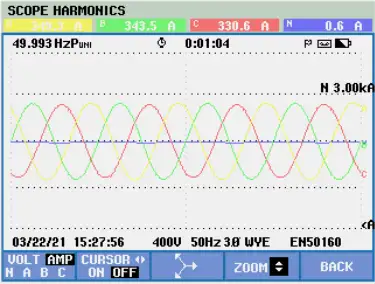
Current waveform before installing the active harmonic filter
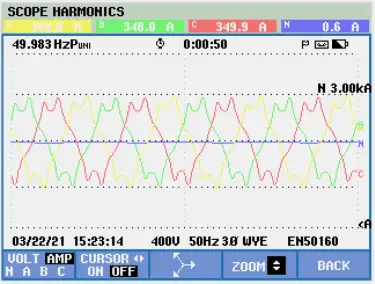
Current waveform after installing the active harmonic filter