
A Brief Introduction to the Applications of AHF (Active Harmonic Filter)
1. What are the causes of harmonic voltage and harmonic current?
The widespread use of nonlinear load devices (such as frequency converters, rectifiers, and LED lighting) leads to severe harmonic pollution in the power grid, causing a series of problems such as equipment overheating, malfunction of protection devices, and decreased power factor.
As a new generation of power quality management equipment, AHF (Active Harmonic Filter) is becoming a core tool for solving harmonic problems in industrial plants.
2.The core characteristics of industrial plants:
Compared with ordinary buildings, industrial plants have more unique power requirements, which determines the necessity of harmonic control.
Large Power Capacity: With a large concentration of production equipment, a single plant’s load often reaches thousands to hundreds of thousands of volt-amperes, making power problems easily amplified.
Diverse Equipment Types: Industrial plants contain a wide variety of equipment, including various machine tools, automated production lines, and power equipment, placing greater pressure on the power system.
High Reliability Requirements: Continuous production means that power fluctuations can lead to downtime, product scrap, and safety accidents.
3.Plant load: the main source of harmonics. Nonlinear loads in the plant are the root cause of harmonic generation, and their harm cannot be ignored.
01. Variable Frequency Drive (VFD) Equipment: Variable frequency drives used for speed control in equipment such as fans and pumps generate significant amounts of characteristic harmonics (5th, 7th, and 11th harmonics) during their rectification-inversion process.
02. Rectifier Equipment: Electroplating tanks, UPS systems, etc., inject non-sinusoidal current into the power grid.
03. Arc Equipment: Arc furnaces and welding machines generate broadband harmonic fluctuations. During arc initiation and welding, large current variations generate numerous harmonics, with the 3rd, 5th, 7th, 11th, and 13th harmonics being particularly prominent.
04. Computers and Servers: Computers generate harmonic currents during startup and program execution, placing high demands on power supply stability and quality.
05. LED Lights: LED light drivers exhibit non-linear characteristics. Under different brightness adjustments, current and power changes are not linear, potentially generating harmonics and affecting power grid quality.
4.The hazards of harmonics include:
Accelerated equipment aging: causing motors and transformers to overheat and shortening their lifespan. Increased power loss: leading to increased line and equipment losses and higher electricity costs. Interference with control accuracy: affecting PLC and sensor signals and reducing production precision.
5.Case Study: Electric Arc Furnace Workshop in a Metallurgical Plant – Addressing Fluctuating Harmonics
Project Background: During operation, an electric arc furnace in a metallurgical plant frequently experienced flickering workshop lighting and false alarms from the PLC control system, sometimes leading to furnace shutdowns with losses exceeding 100,000 RMB per shutdown.
Test Results: During furnace operation, the THDi fluctuated between 15% and 35%, with complex harmonic frequencies that varied with the smelting stage.
Solution: An active filter with a dynamic response speed of ≤10ms was used to track and compensate for harmonic changes in real time.
Application Results: THDi was stably controlled within 8%, flickering lighting and false alarms from the control system disappeared, and the continuous operation rate of the electric arc furnace increased from 85% to 98%.
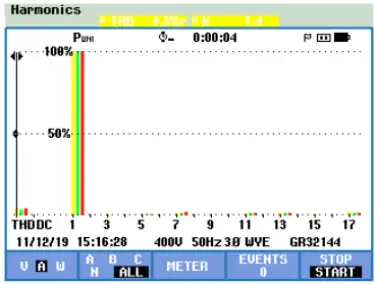
Current spectrum diagram before AHF (Active Harmonic Filter) is put into operation
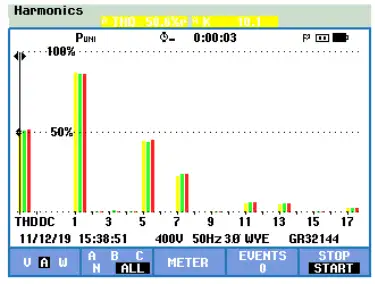
Current spectrum diagram after AHF (Active Harmonic Filter) is put into operation