

How to solve the three-phase imbalance in power quality?
Definition of three-phase imbalance
Three-phase imbalance refers to the inconsistent amplitudes of the three-phase currents (or voltages) in a power system, with the amplitude difference exceeding the specified range. This is caused by uneven load distribution across the phases and is a fundamental load configuration issue. Three-phase imbalance is related to user load characteristics, as well as power system planning and load allocation. In a power grid system, three-phase balance primarily refers to the equal magnitudes of the voltage phasors of the three phases, and if arranged in the order A, B, C, the angle between each pair of phases is 2n/3. Three-phase imbalance refers to the inconsistency in both phasor magnitudes and angles. According to IEC standards, this applies to AC rated frequencies of 50/60 Hz. Under normal power system operation, voltage imbalance at the PCC (Point of Common Coupling) connection point is caused by negative sequence components. The standard stipulates that the allowable imbalance at the PCC under normal operating conditions is 2%, and should not exceed 4% for short periods.
Imagine three horses pulling a large cart. If one horse suddenly becomes weak or exerts too much force, or if one horse does not walk in the same direction, the cart will not only struggle to move in a straight line, but the entire journey will be bumpy and unstable, further consuming the horses’ energy. This is a vivid illustration of three-phase imbalance in a power system. Three-phase imbalance occurs when the amplitude difference of the three-phase current (or voltage) exceeds a reasonable range, or when the phase angle deviates from the standard 120 degrees.
The following figures compare the voltage waveforms and vector diagrams for three-phase balanced and unbalanced conditions.
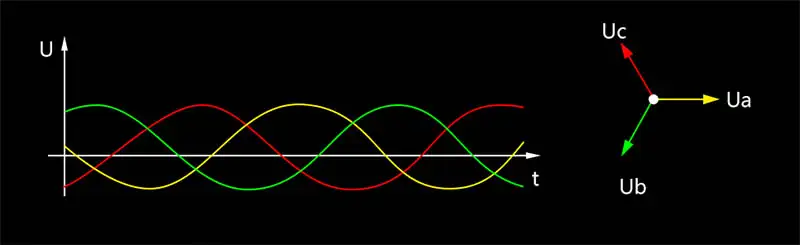
Three-phase balanced voltage waveforms and vector diagrams
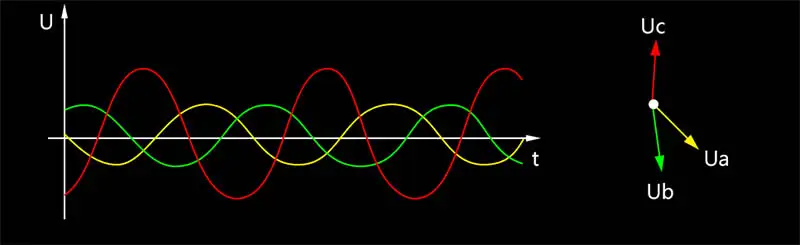
Three-phase unbalanced voltage waveforms and vector diagrams
The dangers of three-phase power imbalance:
1. Reduced equipment lifespan and frequent failures: Three-phase motors are forced to withstand negative sequence current under unbalanced current, much like a heart continuously subjected to abnormal rhythmic impacts. This leads to abnormal motor heating, accelerated aging of insulation materials, abnormal bearing wear, and ultimately premature failure. Transformers face similar predicaments, with decreased capacity utilization and a surge in internal losses.
2. Soaring line losses and energy efficiency degradation: Unbalanced current causes a dramatic increase in neutral current (up to more than twice the phase current), resulting in a surge in additional copper and iron losses in lines and transformers. Studies show that a 1% voltage imbalance can lead to 6%-10% additional motor losses and a significant increase in grid line losses, directly translating into high and unnecessary electricity bills.
3. Malfunctioning protection systems and production interruptions: Precision electronic equipment is extremely sensitive to voltage fluctuations. Voltage fluctuations caused by imbalance can lead to frequent false alarms or shutdowns in PLCs, frequency converters, CNC machine tools, etc., causing unpredictable production losses and quality risks. Relays may also misjudge faults due to unbalanced current, triggering unplanned power outages.
4. Sources of power quality pollution: Three-phase imbalance is one of the important causes of harmonics (especially the third harmonic), which deteriorates the power grid environment, creates a vicious cycle, and threatens more sensitive equipment.
Tracing the Root Causes: What Causes Three-Phase Power Imbalance?
1. Clustering of Single-Phase Loads: In modern buildings, numerous single-phase devices (lighting, computers, air conditioners, charging stations) are randomly connected to different phase lines, lacking scientific planning. When too many high-power devices (such as densely packed air conditioners or electric furnaces) are connected to a particular phase, the load naturally tilts towards that phase.
2. Equipment Defects: Some equipment (such as high-power rectifiers and electric arc furnaces) inherently generate unbalanced currents. Differences in internal impedance of old or poorly maintained equipment can also exacerbate the imbalance.
3. Impact of Asymmetrical Faults: When a single-phase grounding fault or open circuit occurs in the system, it can instantly lead to severe imbalance. Even after the fault is cleared, if the load distribution is not optimized, the imbalance may persist.
4. Imbalance Between Planning and Operation/Maintenance: Early planning of the distribution network did not fully consider load growth patterns and balance requirements; later operation and maintenance failed to dynamically adjust phase sequence allocation according to actual load changes.
The Solution: From Passive Acceptance to Proactive Management
Faced with three-phase imbalance, passively accepting the problem means continuous losses. The solution lies in proactive measures and the implementation of systematic prevention, monitoring, and management strategies:
1. Scientific Planning, Prevention at the Source: Refined Load Forecasting and Allocation: When constructing or upgrading distribution systems, develop scientific single-phase load access schemes based on detailed forecasts of load type, power, and usage periods, striving for three-phase balance. This allows for future adjustments.
2. Dynamic Monitoring, Knowing the Data: Deploying Power Quality Monitoring Systems: Install online monitoring devices on the transformer outgoing lines, important feeders, and key load inlets to collect real-time data on three-phase voltage, current, imbalance, harmonics, and other key parameters. This is the foundation for identifying problems, assessing risks, and verifying the effectiveness of management measures.
3. Proactive Management, Precise “Balance”: Install Static Var Generators (SVG): SVG not only compensates for reactive power, but its advanced control algorithm can also effectively compensate for negative sequence current (the main component of imbalance), offsetting the impact of imbalance at its source. It is particularly suitable for managing problems caused by unbalanced loads themselves (such as electric arc furnaces and rolling mills).


