

How to Choose an Industrial 480/380V Transformer for the North American (US, Canada, etc.) Market?
The mainstream voltage of the US industrial power grid is 480V, 60Hz, while most industrial equipment in China and Europe has a rated input voltage of 380V, 50Hz. This necessitates dedicated voltage conversion equipment—a 480V to 380V transformer. More importantly, electrical equipment exported to the US must be UL certified. We will analyze transformer selection based on US UL certification requirements.
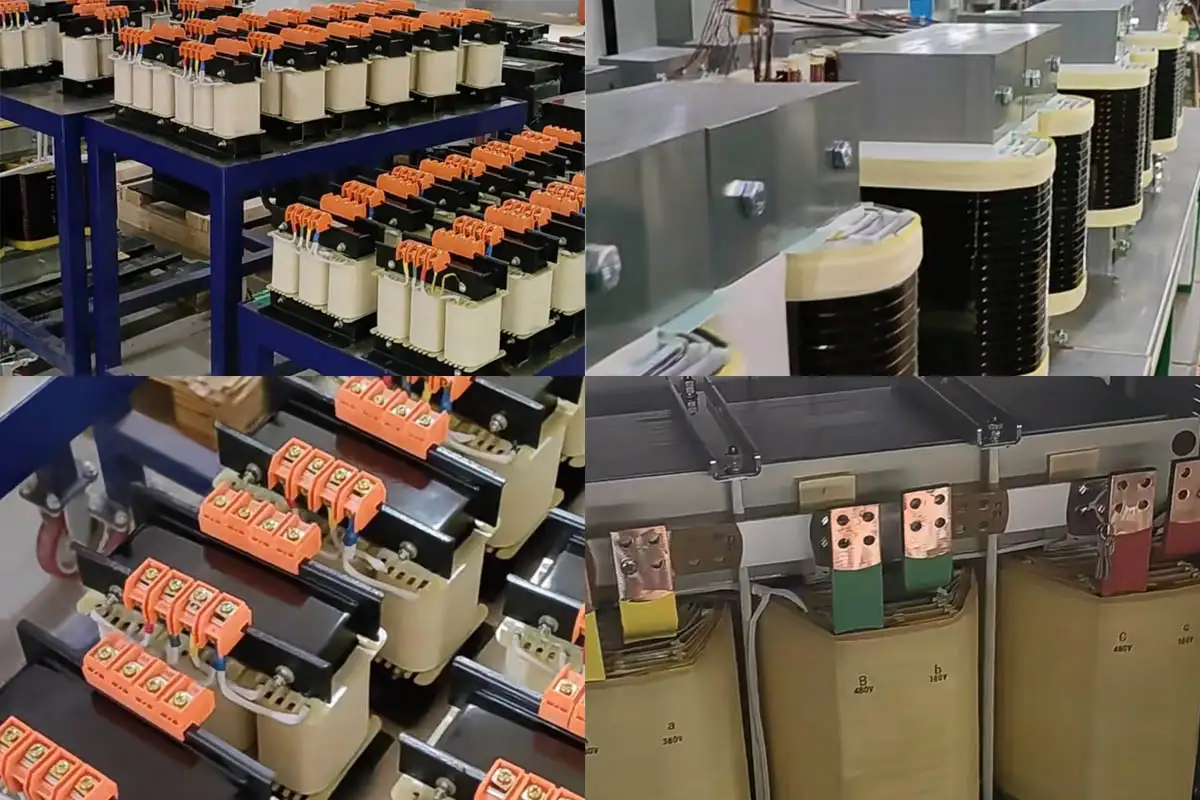
For 480V to 380V industrial transformers, the core UL standard that the US market mandates is:
UL 5085-1: A general safety standard for industrial low-voltage transformers, covering core requirements such as electrical safety, temperature rise control, and short-circuit withstand. It is the core basis for whole-machine certification, and the product must clearly indicate “UL 5085-1 Listed,” not just “UL Recognized” for individual components.
UL 1446: Insulation system certification. The insulation materials of critical components such as transformer windings and cores must pass this standard certification. Suppliers are required to provide relevant UL 1446 insulation system certification documents.
Supplementary requirements: If the transformer is used in specific scenarios such as photovoltaic inverters or charging piles, it must also comply with specific standards such as UL 1741. If it is also suitable for the Canadian market, CSA C22.2 No. 66 certification can be added to improve product compatibility.
How can users verify the authenticity of UL certification?
Official Website Inquiry: Log in to the official UL website (www.ul.com), enter the UL file number provided by the supplier (the search results must be completely consistent with the product model, parameters, and manufacturer information to confirm the certification is valid).
Certificate Verification: Require the supplier to provide a complete UL certification certificate, focusing on verifying the product specifications (480V to 380V), certification standards, validity period, and that the manufacturer name matches the actual supplier.
Nameplate Verification: The transformer’s nameplate must clearly display the “UL Listed” mark, UL file number, and certification standards. The printing must be clear and durable, without fading or blurring, and the character height must be no less than 1.0mm. This is a mandatory requirement for UL-certified products.
After confirming the validity of the UL certification, it is necessary to determine whether the transformer parameters match the site conditions:
1. Input and Output Voltage:
Must strictly correspond to “Input 480V, Output 380V”.
Most transformers use three-phase 480V input and three-phase 380V output. The transformer connection group (• 1. Tap Adjustment: It is recommended to select a transformer with a voltage adjustment tap (±5%). This allows for fine-tuning of the output voltage according to local US grid voltage fluctuations, ensuring stable equipment operation, especially suitable for areas with unstable grid voltage.
2. Frequency Compatibility:
Compatible with 60Hz US Grid The US industrial grid frequency is 60Hz, while the Chinese grid is 50Hz. A 50Hz/60Hz compatible transformer should be selected.
3. Capacity Selection: Sufficient margin is required to avoid overload.
The transformer capacity (unit: kVA) needs to be selected reasonably based on the total power, starting current, and load characteristics of the exported equipment, with sufficient margin. The following are suggested selections:
General industrial equipment (e.g., fans, pumps): A safety margin of 1.2-1.5 times is recommended. For example, if the total power of the equipment is 80kVA, a 100-120kVA transformer should be selected.
Impulsive load equipment (e.g., CNC machine tools, injection molding machines): The starting current is high; a safety margin of 1.5-2 times is recommended to avoid overload and transformer burnout during startup.
Precision equipment (such as testing instruments and servo systems): Harmonic losses need to be considered additionally; it is recommended to allow for a margin of at least 1.5 times the rated value, and to select a model with a K-factor compatible to suppress harmonic interference.
4. Insulation and Temperature Rise: Compliant with UL standards to ensure safety.
The UL 5085-1 standard has specific requirements for the insulation class and temperature rise of transformers:
Insulation Class: For industrial applications, H-class insulation (temperature resistance 180℃) is preferred. It has stronger high-temperature resistance and aging resistance, and can adapt to the environmental temperature differences in different regions of the United States, avoiding insulation aging and short-circuit faults caused by high temperatures. For general applications, F-class insulation can be selected, but it must be confirmed that it meets UL certification requirements.
Temperature Rise Control: The UL standard requires that the winding temperature rise be ≤75K (winding temperature ≤115℃ at an ambient temperature of 40℃). It is also necessary to ensure that the transformer has a complete heat dissipation structure (such as forced air cooling or natural cooling) to adapt to the high-temperature environment of industrial applications.
5. Protection Rating: Adaptable to the Operating Environment, Preventing Damage
The protection rating (IP rating) needs to be selected based on the transformer’s operating scenario. Common protection ratings for industrial transformers exported to the United States are as follows, which can be flexibly selected based on the equipment installation environment:
IP20: Dry indoor environments (e.g., workshops, machine rooms), no dustproof or waterproof requirements, suitable for installation in enclosed control cabinets.
IP54/IP55: Dustproof and water-spray resistant, suitable for outdoor or semi-outdoor environments (e.g., photovoltaic power stations, outdoor equipment), must pass salt spray testing (ASTM B117 standard), to avoid terminal corrosion in coastal areas.
IP65 and above: Completely dustproof and water-spray resistant, suitable for harsh environments (e.g., chemical plants, mines), must confirm that the protection rating passes relevant UL tests.
6. Energy Efficiency Standard: Compliant with US DOE Regulations, Reducing Long-Term Costs
The US Department of Energy (DOE) has mandatory energy efficiency requirements for dry-type transformers (10 CFR Part 431). Products that do not meet energy efficiency standards cannot enter the US market. When purchasing, it is necessary to confirm that the transformer complies with DOE regulations. The 2016 energy efficiency regulations specify the following requirements: no-load loss for VA and below should be ≤1.2% of rated capacity, and no-load loss for VA between 50-100kVA should be ≤0.8% of rated capacity.


