

Comparative Analysis of SVG and SVC Reactive Power Compensation Devices
1. Different Working Principles
1.1 SVC can be considered a dynamic reactive power source. Depending on the grid connection requirements, it can provide capacitive reactive power to the grid or absorb excess inductive reactive power. Capacitor banks, typically connected to the grid as filter banks, can provide reactive power. When the grid does not require much reactive power, this excess capacitive reactive power is absorbed by a parallel reactor. The reactor current is controlled by a thyristor valve group. By adjusting the thyristor trigger phase angle, the effective value of the current flowing through the reactor can be changed, thus ensuring that the reactive power at the grid connection point of the SVC can stabilize the voltage at that point within a specified range, achieving the function of reactive power compensation for the grid.
1.2 SVG uses a high-power voltage-source inverter as its core. By adjusting the amplitude and phase of the inverter’s output voltage, or directly controlling the amplitude and phase of the AC side current, it can quickly absorb or generate the required reactive power, achieving the purpose of rapid dynamic adjustment of reactive power.
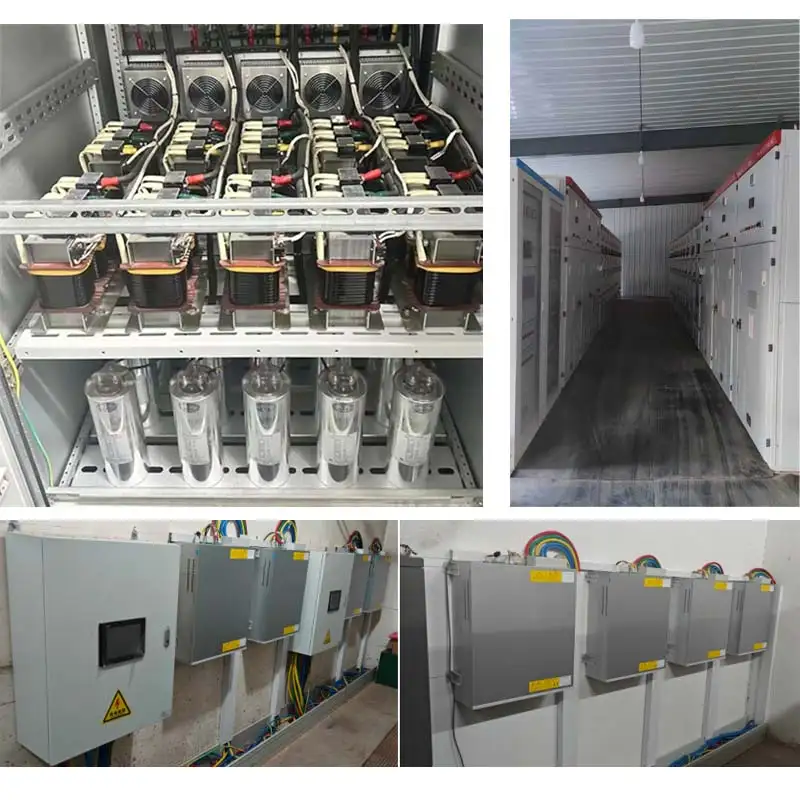
2. Fast Response Speed:
The response speed of a typical SVC is 20-40ms; while the response speed of an SVG is no more than 5ms. This allows for better suppression of voltage fluctuations and flicker. Under the same compensation capacity, SVG offers the best compensation effect for voltage fluctuations and flicker.
3. Excellent Low-Voltage Characteristics:
SVG has the characteristics of a current source, and its output capacity is minimally affected by the bus voltage. This advantage makes SVG highly effective for voltage control. The lower the system voltage, the greater the need for dynamic reactive power regulation. SVG’s excellent low-voltage characteristics mean that its output reactive current is independent of the system voltage, allowing it to be considered a controllable and constant current source. Even when the system voltage decreases, it can still output rated reactive current, possessing strong overload capacity.
In contrast, SVC has an impedance-type characteristic, and its output capacity is greatly affected by the bus voltage. The lower the system voltage, the proportionally lower the reactive current output capacity, lacking overload capacity. Therefore, the reactive power compensation capability of SVG is independent of the system voltage, while the reactive power compensation capability of SVC decreases linearly with the decrease in system voltage.
4. Improved Operational Safety:
SVCs (Self-Controlled Reactors) rely on thyristor-regulated reactors and multiple capacitors for reactive power compensation, making them highly susceptible to resonance amplification, leading to safety accidents. Large system voltage fluctuations significantly impact compensation effectiveness and result in high operating losses. SVG (Static Var Generator) capacitors, on the other hand, do not require filter banks and do not exhibit resonance amplification. As an active compensation device using IGBTs (Inductively Coupled Bit Transistors), SVG avoids resonance and significantly improves operational safety.
5. Harmonic Characteristics:
SVCs utilize thyristors to control the equivalent fundamental impedance of the reactor, making them highly susceptible to system harmonics and generating their own harmonics. Requires filter banks to remove these inherent harmonics. SVGs employ three-level single-phase bridge technology, outputting a 5-level voltage waveform per phase. Using carrier phase-shift pulse modulation, they are less affected by system harmonics and can suppress them.
Compared to SVCs, SVGs, through multiplexing, multi-level, or pulse width modulation techniques, significantly reduce the harmonic content in the compensation current.
6. Small Footprint
For the same compensation capacity, the footprint of an SVG is reduced by 1/2 to 2/3 compared to a SVC. Because SVG uses fewer reactors and capacitors than SVC, the overall size and footprint of the device are significantly reduced; the reactors in an SVC are not only relatively large in themselves, but also have a larger overall footprint considering the installation spacing between them.
In summary, SVG reactive power compensation devices have advantages such as fast response speed, low harmonic content, and strong reactive power regulation capability, which can greatly improve the power quality of the power grid and have become the development direction of reactive power compensation technology.


