

Detailed Explanation: Transformer Silicon Steel Sheets
A transformer mainly consists of an iron core and conductors. The iron core is primarily made of laminated silicon steel sheets. Silicon steel sheets are steel sheets with a silicon content of 0.8% to 4.8%, possessing strong magnetic permeability. In a transformer, silicon steel sheets can generate a large magnetic induction intensity, and their performance determines the size of the transformer.
Silicon steel sheets determine the power loss of a transformer.
When a transformer is operating, it generates power losses. There are two main types of losses: copper losses due to the resistance of the coils, and iron losses in the silicon steel sheets, simply called “iron losses.” There are two causes of iron losses in silicon steel sheets: “hysteresis loss” and “eddy current loss.”
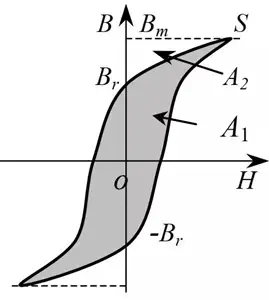
Hysteresis loss is the iron loss generated during the magnetization process of the iron core due to the existence of magnetic hysteresis. The magnitude of this loss is directly proportional to the area enclosed by the hysteresis loop of the material. Silicon steel has a narrow hysteresis loop, resulting in lower hysteresis losses in the transformer core, which significantly reduces heat generation.
Transformer Hysteresis Curve (Figure 1)
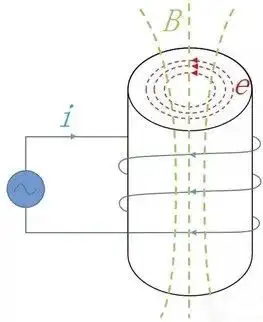
Eddy current loss is caused by induced currents generated in the iron core, circulating in a plane perpendicular to the magnetic flux direction. It is also the cause of core heating. To reduce this loss, silicon steel sheets are laminated to increase the resistance in the eddy current path.
Transformer Eddy Current Loss (Figure 2)
How Silicon Steel Sheets Generate Magnetic Flux and Affect Voltage Step-Up and Step-Down
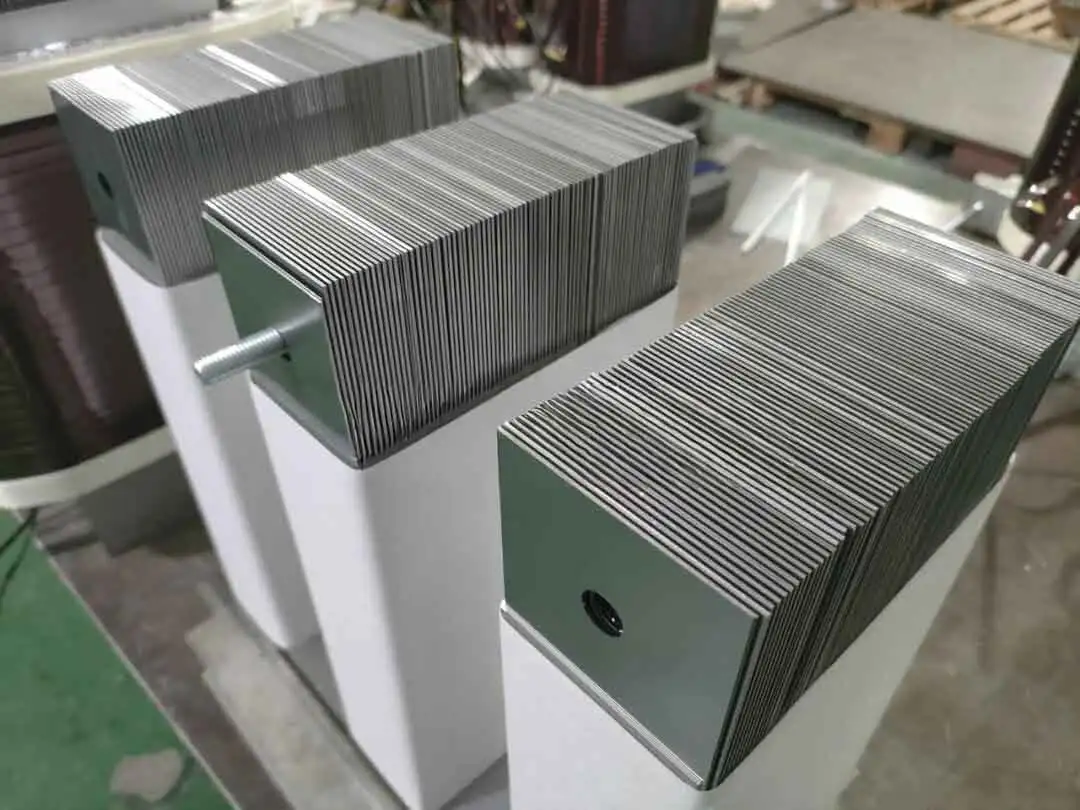
The silicon steel sheets determine the power loss of the transformer. As mentioned above, their size and shape are important factors affecting power loss. Theoretically, the thinner the silicon steel sheets and the narrower the spliced strips, the better the effect. However, the efficiency and effective cross-section of the lamination must also be considered. Generally, transformer cores use 0.35mm thick “日”-shaped or “口”-shaped cold-rolled silicon steel sheets.
Transformer Core Lamination (Figure 3)
Transformers are made based on the principle of electromagnetic induction. Two windings, a primary winding and a secondary winding, are wound on a closed iron core. When the primary winding is connected to an AC power supply, an alternating current flows through it, creating a magnetomotive force (MOF). Under the influence of this MOF, an alternating magnetic flux is generated in the iron core.
According to Lenz’s law, the magnetic flux generated by the induced current opposes the change in the original magnetic flux. As the induced current increases, the magnetic flux generated is opposite to the original magnetic flux, resulting in a lower-level alternating voltage in the secondary winding. Therefore, the iron core is the magnetic circuit part of the transformer, which explains its step-up and step-down voltage principle.
Performance Indicators for Silicon Steel Sheet Selection:
A. Low Iron Loss: The most important quality indicator. Countries worldwide use iron loss values to classify grades; the lower the iron loss, the higher the grade and the higher the quality.
B. High Magnetic Induction Intensity: Silicon steel sheets that achieve higher magnetic induction under the same magnetic field result in smaller and lighter motor or transformer cores, saving on silicon steel sheets, copper wire, and insulation materials.
C. High Stacking Factor. Silicon steel sheets have a smooth, flat, and uniform thickness, which improves the stacking coefficient for core manufacturing.
D. Good stamping properties. This is even more important for manufacturing cores for small and micro motors.
E. Good adhesion and weldability of the surface to the insulating film.
F. Magnetic aging.
G. Silicon steel sheets must be delivered after annealing and pickling.


